How Varnan Scaled Comnyang from 0 to 500+ Sales in a Week
Tue, Jun 9, 2026 · 11 min read
TL;DR
- Client: Comnyang, a pixel cat that sits on your desktop and reacts to what you're doing, built by an indie maker named Simon
- Challenge: A lovely little product with a working app and not a single sale to show for it
- What Happened: Varnan found Comnyang during product research, then spent seven days mapping its ICPs, studying comparable content, refining the positioning, and engineering a short-form campaign for Paras Madan's 237k channel.
- Results: $0 to $2,368 in revenue, 524 paying orders in a week, 3.3M views, 122K likes
- Then: The positioning gave other creators a clear story to adapt, extending the campaign from Instagram to X and introducing Comnyang to new audiences
The Product: Comnyang
Comnyang is a pixel cat that sits on your desktop and reacts to whatever you're doing. You're typing, the cat does its thing. You leave it alone, it does something else. It's small, it's animated, and you get the whole idea in about two seconds of watching it move.

The thing that makes Comnyang easy to sell is how fast you get it. There's no concept to explain. You see the cat on the screen, you understand what it is, and you either want one or you don't. Most people who watch it for a few seconds want one.
Simon built it, shipped it, and it ran exactly as intended. It had also sold zero copies.
The Challenge: A Good Product Nobody Was Buying
Comnyang's problem wasn't the product. Anyone who looked at it could tell it was charming and finished. The problem was that almost nobody had looked at it.
A small indie launch gives you a short burst of attention from people who already follow that corner of the internet. After that burst, the page goes quiet and the product sits there. Comnyang had gone through that cycle and come out the other side with a working app and an empty order count.
There was no one posting about it, no video showing it off to people outside the maker bubble, and no reason for a regular person scrolling their phone to ever cross paths with it. A desktop cat is something most people would happily pay a few dollars for once they see it. The catch is they have to see it first, and nobody was showing them.
How We Found It
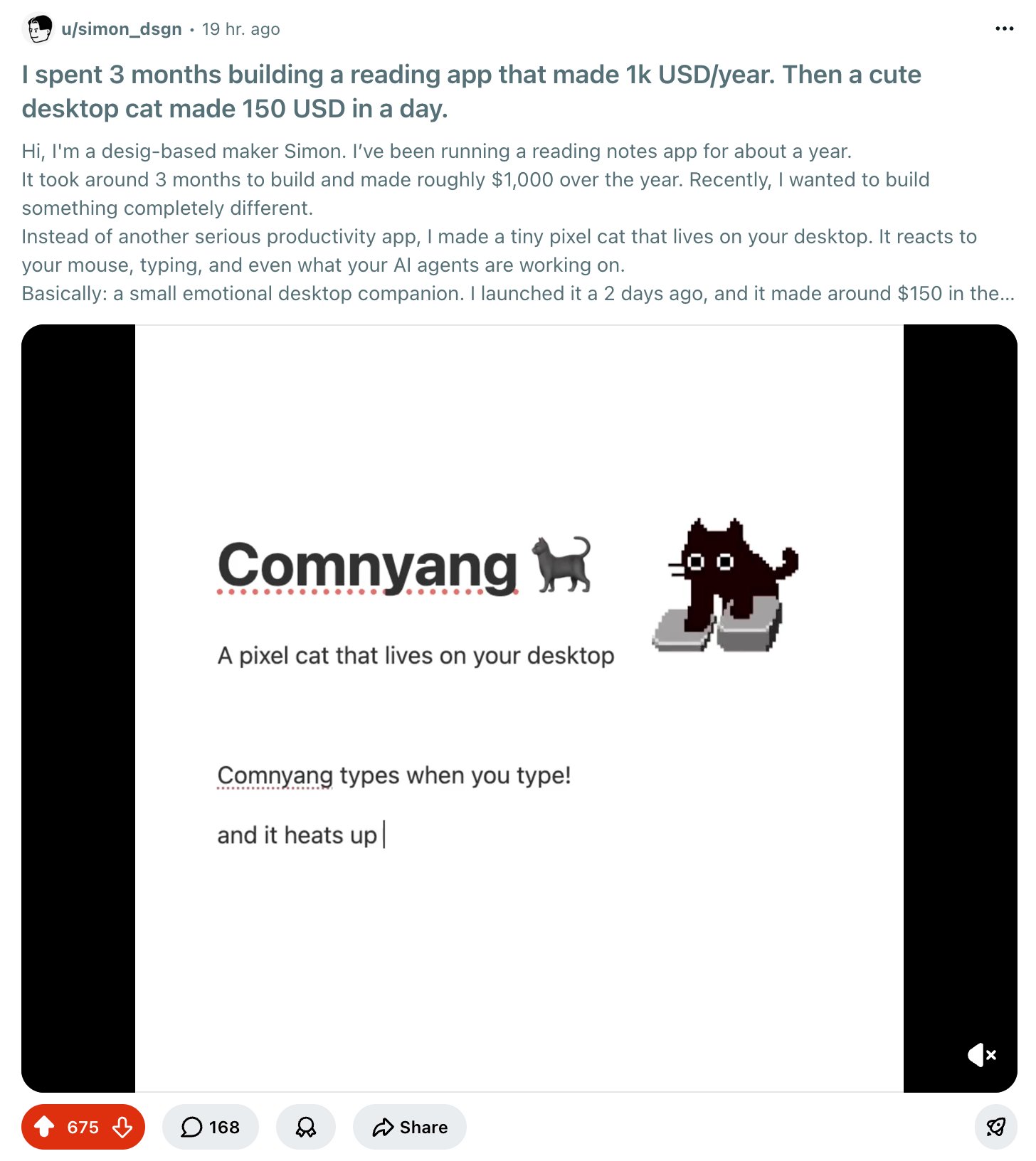
Comnyang surfaced on Reddit during Varnan's product research. The post had earned a small burst of attention, but the product had not reached the audiences most likely to buy it. Shubhranshu, who runs distribution at Varnan, flagged it for a deeper review.
The team saw several useful signals. Comnyang made sense on sight, worked without a technical explanation, and gave viewers an obvious reason to send it to a friend. Those traits made it a strong candidate for short-form distribution, where the first seconds decide whether someone keeps watching.
The Reddit post was the discovery point. The decision to build a campaign came after the team studied the product, the market around it, and the audiences that could carry it further.
I was looking for a product that grabs people visually and is easy to convey. Comnyang was exactly that, a desktop cat you understand the second you see it, even with the sound off.
- Shubhranshu Shekhar Dash, Distribution Lead at Varnan
The Seven-Day Growth Sprint
Varnan spent seven days turning the initial product signal into a campaign. The team studied how desktop companions, cozy productivity products, and small consumer apps were presented across Reddit, Instagram, and X. They mapped the audience clusters most likely to care, including desktop customization fans, students, remote workers, cat lovers, and people who follow indie products.
The research led to one positioning decision: present Comnyang as a companion viewers understand the moment it moves. That idea shaped the script, the footage, the pacing, and the distribution plan.
The team then engineered a 25 to 30-second Instagram Reel as the campaign's hero asset and published it on Paras Madan's 237k channel. The content had four jobs: stop the scroll, make the product clear without sound, show proof on a real desktop, and give viewers a reason to share it.
The goal was to give the viewer the most in the least time. On a phone you have a couple of seconds before someone flicks past you, so every part of the video earns its place.
The hook lands first, in plain words. The video opens with language anyone recognizes, words like "cute" and "companion." That does something useful. It takes a piece of software and makes it feel familiar before the viewer has to think about it. You're handing them a feeling they already have about cats, before a single product detail shows up.
Then it says what the thing actually is, and who made it, early. A lot of videos save that reveal for the end and lose people before they reach it. A viewer who still doesn't know what they're looking at fifteen seconds in has usually already swiped. So the introduction lands right after the hook, while attention is still high.
Then the cat actually working. This is the part that carries the most weight after the hook. People need to feel that the thing is useful, so the middle of the video is the product doing its job on the desktop, the cat reacting to what's happening on screen. Showing it beats describing it every time.
Then the close, on credibility. The video ends on the website, so people have somewhere to go. That's the move that turns a view into a save, a share, and an order. The ending is a clean handoff to the place they can get it.
Shubhranshu wrote the script after the research phase and assembled each shot around the audience and sharing behavior the team had mapped. The research and distribution plan determined the final Reel.
The Numbers
The Reel did 3.3M+ views and 122K likes, reached 1.89M accounts, and pulled 66K shares and 50K saves. Comments stayed around a hundred, but the shares and saves are where the spread lives. People forwarded the video to someone who needed a desktop cat instead of arguing about it in the replies.
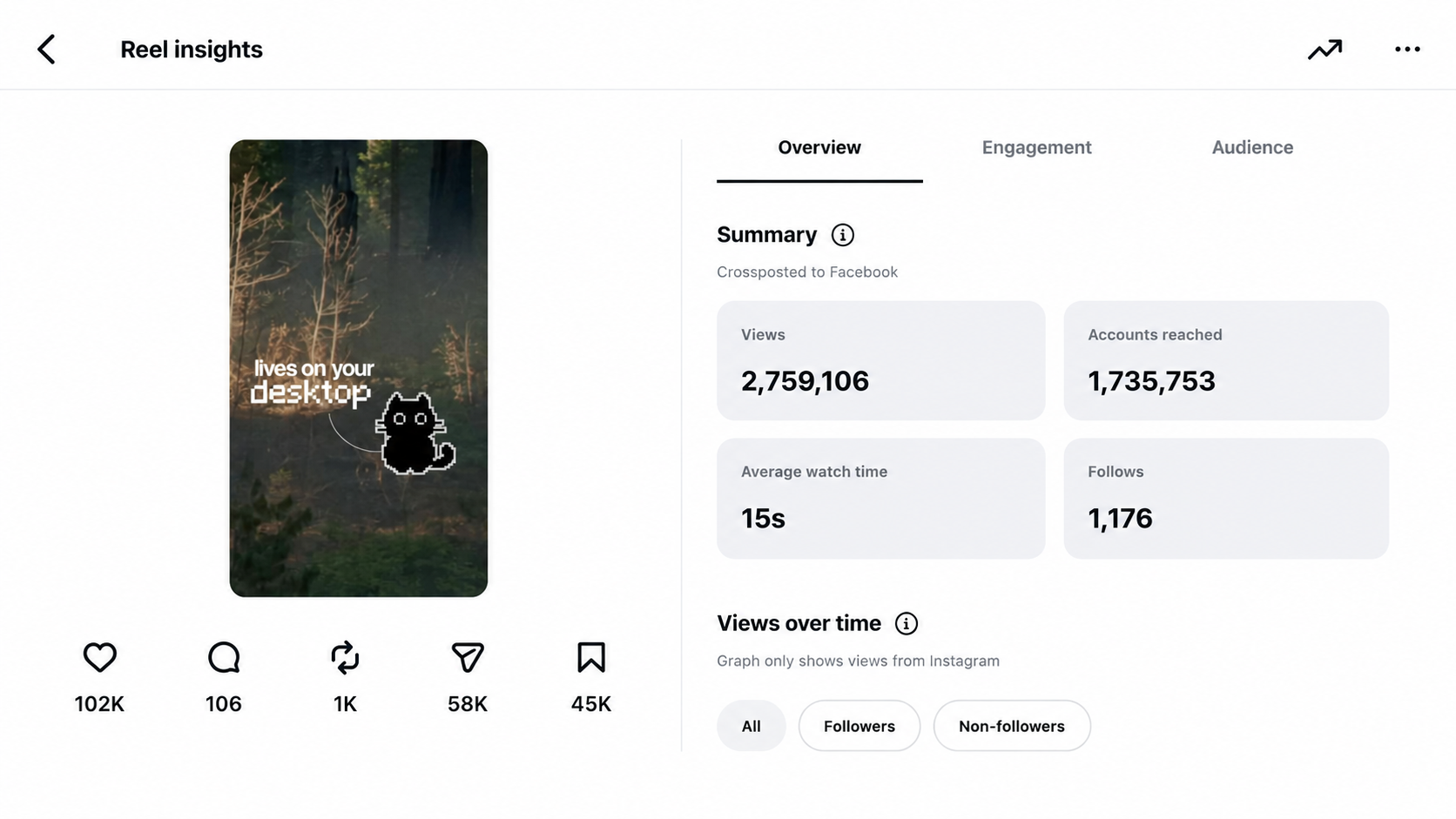
Here is the campaign's hero asset:
The Comnyang reel on Paras Madan's channel
On Simon's side, the dashboard went from a flat line to a wall:
- Revenue: $0 to $2,368
- Orders: 524 paying customers
- Time: a week, not months
The 524 orders didn't all land in one sitting. They came in as a wave that built and then tapered as the video kept spreading:
- June 5: 50 orders
- June 6: 152 orders
- June 7: 95 orders
- June 8: 62 orders
- June 9: 60 orders
- June 10: 33 orders
- June 11: 45 orders
- June 12: 27 orders
The big day was June 6, right as the Reel hit its stride, and the sales kept coming for days after instead of spiking once and dying.
The revenue confirms that the campaign converted attention into purchases. A product that had earned nothing took 524 orders from real people in a week. That's 524 strangers who watched the content, visited a site they had never seen, and paid. For an indie maker sitting at zero, that customer count provides clear evidence of demand.
The Virality Loop
The campaign was built to move beyond the first audience. Varnan gave viewers a product they could understand without context and a simple reason to pass it on. That structure produced two clear forms of amplification.
The comments turned into a checkout line. The replies filled up with people asking where to get it and tagging friends who needed a desktop cat. Every tag pulled in a new person who watched, wanted one, and often tagged someone else. The video became something people forwarded.
Then creators adapted the story. The core idea was easy to repeat: a pixel cat lives on your desktop and reacts to your work. Creators on X reused that framing with their own clips and commentary. Each version carried the same positioning into a different audience without needing a new explanation.
The Memecoin
The campaign also carried the Comnyang name into spaces outside the product's original audience.
While the video was spreading, someone spun up a memecoin off the Comnyang name on Solana. Simon found out the way you'd expect, by seeing his own product's name attached to a coin he'd never heard of. He didn't make it or authorize it, and he had no link to whoever did.
He handled it with a level head. He posted a warning that the coin wasn't official, then noticed something he hadn't expected. Creator fees from the coin had quietly piled up in a Pump.fun account tied to the name, and he couldn't give them back.
It's honestly surprising to see that around $300 has accumulated in my Pump.fun account. I actually looked into ways to return this amount to the platform or the buyers, but due to the nature of the blockchain system, there is no technical way to reverse the claim. Since these fees were generated by using Comnyang's name without permission, I have decided to allocate this $300 entirely toward the development costs of the actual Comnyang project.
- Simon, maker of Comnyang
The coin itself climbed to a $13,300 market cap before it settled, all off a name stuck to a desktop cat that the maker had nothing to do with.
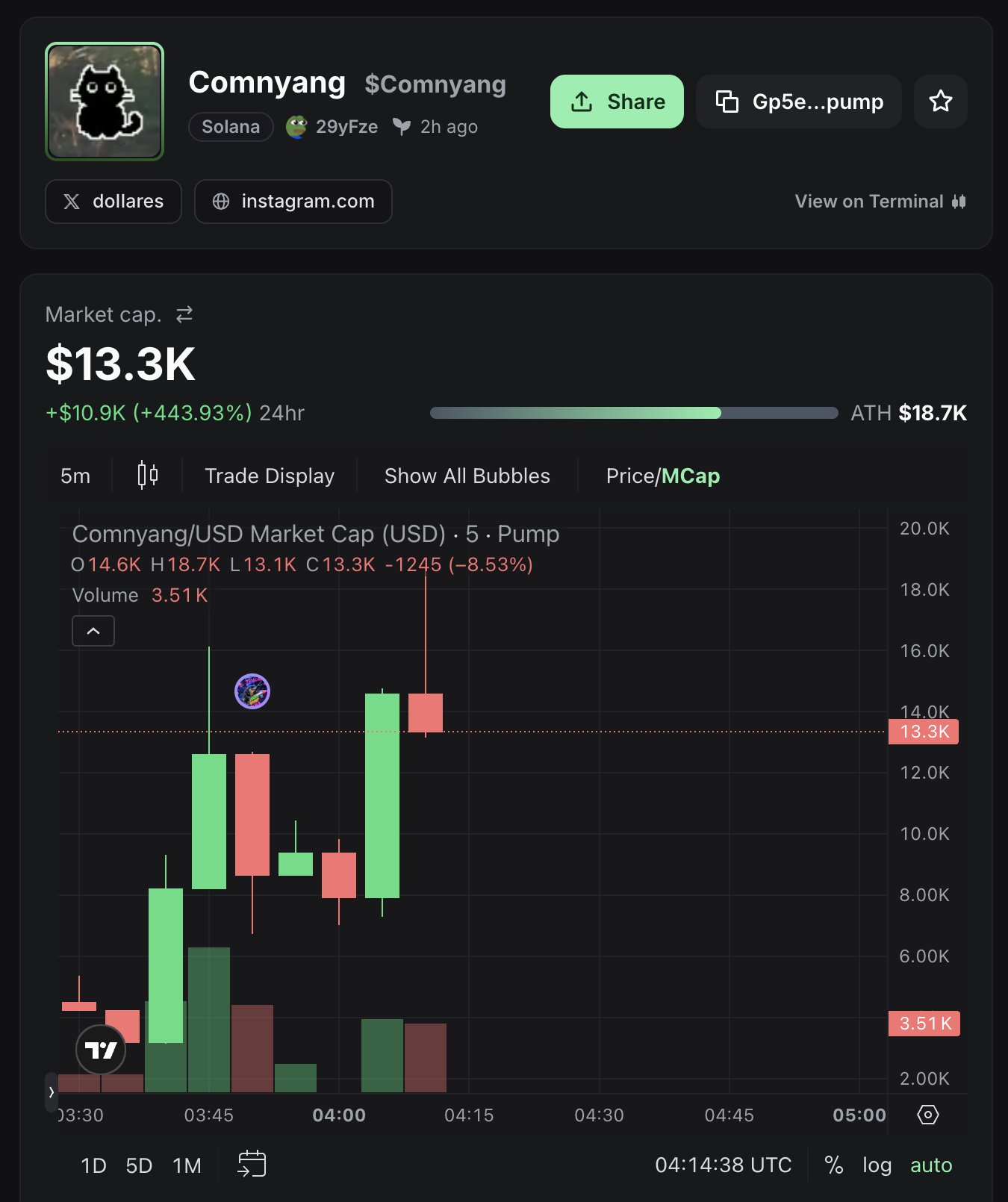
We include this because it shows how far the campaign carried the product name. Comnyang went from zero sales to enough cultural recognition for someone outside the project to mint a coin in the same week. The coin had no connection to Varnan or Comnyang, and Simon directed the fees he could not return toward the actual product.
What Simon Said
Simon posted about the sales jump while it was happening. His numbers came from a day or two before the final figures above, while the campaign was still gaining reach.
Comnyang went viral on IG. It reached 2.2M views and 81.6K likes and it gave Comnyang's sales a huge boost. I was expecting around 10 to 20 sales a day based on my previous data. Paras and team just did a splendid job at video.
- Simon, maker of Comnyang
Simon expected 10 to 20 sales a day. The campaign moved well beyond that range and kept producing orders for a full week.
Why It Worked
Comnyang worked because Varnan matched the product, audience, message, and format before production began. The team identified the people most likely to care, studied the language and examples already moving through those communities, then built the content around Comnyang's strongest visual behavior.
The opening created recognition. The product demo supplied proof. The close gave people a place to act. Clear positioning also made the story easy for other creators to retell, which extended the campaign beyond the original post. The 3.3M views came from that system working across each stage.
We've Run This Before
Comnyang isn't the first quiet product we've put in front of the right crowd.
A developer built his own text-to-image model and posted it to Reddit. It picked up some attention there and then went quiet once the thread cooled. Varnan studied the product, reframed it for a wider audience, and built an Instagram Reel around the visual proof. Chroma pulled 750K views, 22.6K likes, and 318 comments, sending a new wave of people back to the project.
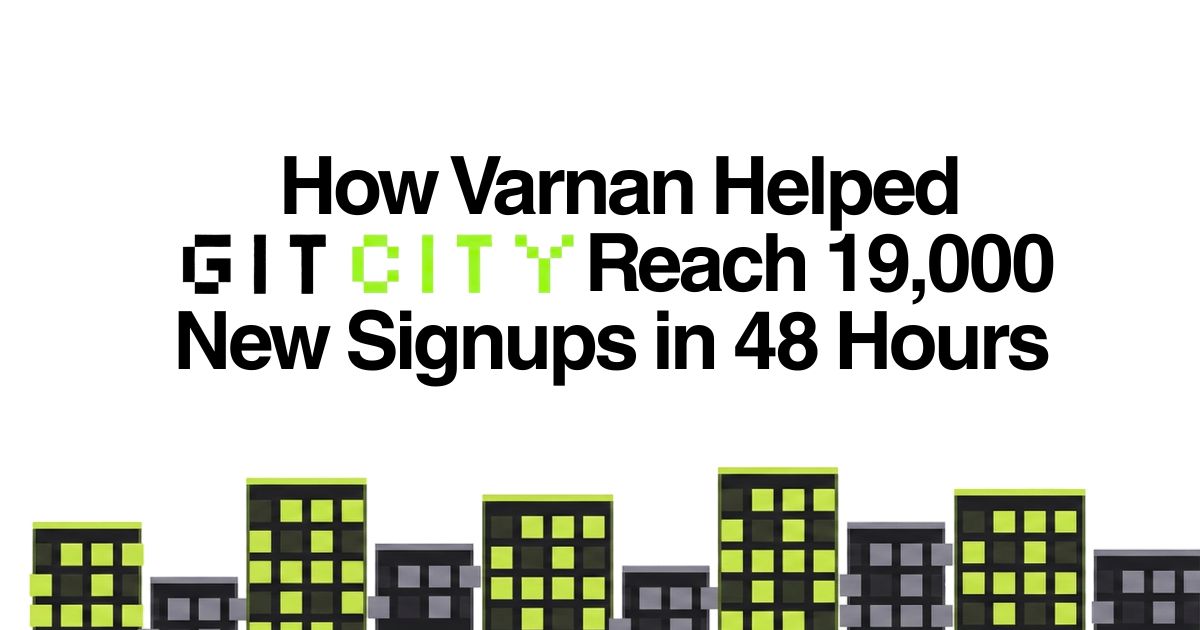
Before that, Varnan applied the same research, positioning, and distribution process to Git City and watched daily signups rise from 211 to more than 19,000 new developers in 48 hours.
The same engine has now worked on a pixel cat, a text-to-image model, and a 3D developer world. Each campaign used different audience insights and creative choices while following the same process: research the product, map the ICPs, sharpen the positioning, engineer the content, and plan the distribution.
Virality depends on the product, timing, audience response, and platform distribution. Varnan repeats the work that improves the odds: product research, ICP mapping, positioning, content engineering, distribution, and measurement.
Frequently Asked Questions
What happened before the campaign went live?+
Varnan spent seven days studying Comnyang, its market, and the audiences most likely to buy or share it. The team reviewed comparable content, mapped ICPs, tested positioning angles, and planned how the first post could lead to shares, saves, creator coverage, and sales. Publishing was the final step in that process.
What does the 524-customer result prove?+
It shows that the campaign converted attention into demand. In one week, 524 people chose to pay for a product that had recorded no sales before the strategy went live. The $2,368 in revenue confirms the conversion, while the customer count shows the breadth of demand.
How was the short-form campaign engineered?+
The team matched the format to the way people understand Comnyang. The opening framed it as a desktop companion, the middle showed it reacting on a real screen, and the close sent viewers to the website. The content worked without sound and gave viewers a simple idea they could share in one sentence.
What was the memecoin about, and were you involved?+
An unaffiliated person created a memecoin using the Comnyang name on Solana while the campaign was spreading. Neither Varnan nor Simon had anything to do with it. Simon publicly warned people it wasn't official, then directed the creator fees he couldn't return toward Comnyang's development. We mention it because it shows how far the product name traveled during the campaign.
Can Varnan guarantee the same result for every product?+
Virality depends on the product, market, timing, and audience response. Varnan repeats the system that improves the odds: product research, audience mapping, positioning, content engineering, distribution, and measurement. You can read the Git City and Chroma case studies here.
Why publish this result?+
Because the campaign proved that 524 people would pay for a product that had recorded no sales before the strategy went live. The revenue confirms the conversion. The larger result is a tested growth system that connected product research, positioning, content, distribution, creator amplification, and sales.
Three High-Impact Moves in 15 Days
The result came from a connected system: product research, audience mapping, positioning, content engineering, and distribution. Varnan Ignition packages that process into a fixed 15-day sprint, so you can evaluate the work before committing to anything longer.
Here's what's inside:
- Media on a 250K network. Your product placed in front of an organic audience of 250,000 through content built for it.
- A taste of Reddit marketing. Strategic placement in the communities your users already sit in, with a credible presence rather than a drive-by post.
- 5 design partners. Sourced from our founder and operator network, so you get structured feedback from people who have built and shipped.
The shape is simple: apply, a 45-minute onboarding call, 14 days of execution, then results in your hands. 15 days, $2,000, and you keep everything we build. No commitment past the sprint.
Are you a Good Fit?
We don't work with everyone. We work best with founders who have a product, traction, and are ready to accelerate growth.
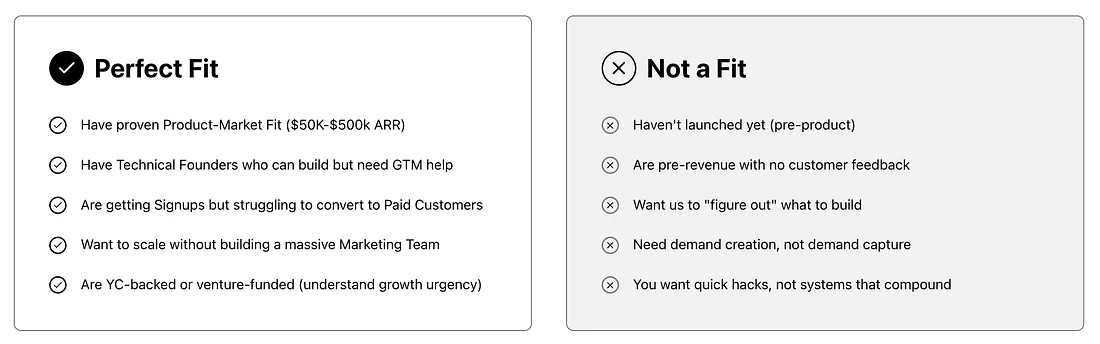
If you've built something worth discovering, Varnan will help the right people find it.
Book a strategy session
Varnan will analyze your product positioning, identify your target audience, and outline a 90-day plan tied to measurable results. Book a strategy session.